Ημερίδες – Συνέδρια – Συμπόσια – Ομάδες Εργασίας2025-2026
GASi 49th Winter Workshop
Nationality, Identity, Culture: Group-Analysis to Build Foundation Myths.
Dates: 16-18 January 2026
Location: Pescara, Italy (in-person Event)

Description: A founding myth is a shared narrative, often symbolic, that serves to create, strengthen and perpetuate the identity of a group, community or nation. These myths represent the origins, values and historical roots that are important for social cohesion, offering a sense of belonging and stability.
The aim of the workshop is to analyse how group analysis can contribute to the construction of founding myths, revealing the collective processes that shape the sense of belonging and identity. A journey of reflection on how shared narratives can strengthen or challenge our symbolic and cultural worlds.
Members will explore the topic through group experiences and dialogues.
Speakers:
Prof. Raffaele Menarini – Neoteny and Personality
Monica Martelli, PhD – Self-awareness (is) awareness of others. Individual time and historical time: Inferences and conditioning
Gerhard Wilke – The Social Matrix is teh Matrix of the Group
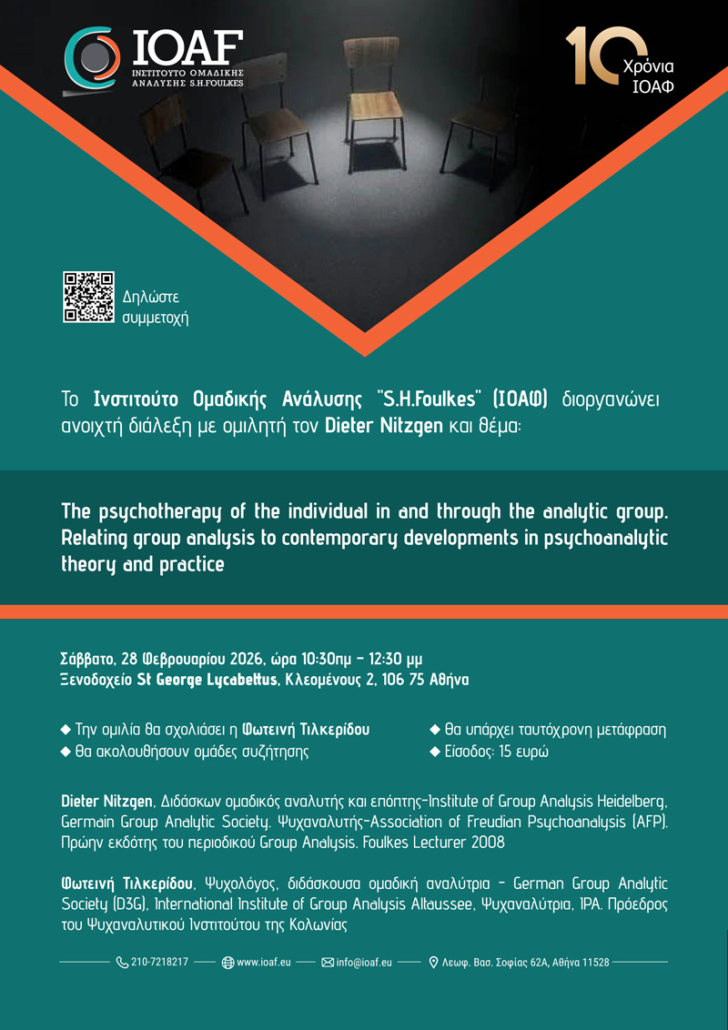
ΙΟΑΦ
Ανοικτή Διάλεξη
28/2/2026
EGATIN Study Days & AGM 2026
U TUZLA, BOSNIA AND HERZEGOVINA 24/04/2026 – 26/04/2026
‘How the post truth discourse in society may be reflected in our groups and group analytic training’

Introduction
We live in challenging times, times of proliferation of fake news, alternative facts, conspiracy theories, alternative realities and other narratives that blur the line between truth and falsehood, truth and lies, change certain established forms of cognition or, in a word, in a time described by the quite popular term post-truth. The rise of post-truth discourse coincides with the growth of general dissatisfaction and fear triggered by various and rapid natural and social changes, shaken security and broken trust. It seems as if facts have ceased to be important and that truth is no longer a reason for believing or disbelieving in something.
Truth and falsehood, facts and fantasies, narratives and reality, meanings and explanations, individual and social, subjective and intersubjective, inner and outer world, individual unconscious, social and collective unconscious are at the basis of group-analytic events from encounter to encounter. Our groups, group-analytic setting, that microcosm immersed in social context creates a climate for questioning both our inner and outer world and searching for truths and answers in building or rebuilding trust and security in ourselves and the world around us.
Precisely, at the EGATIN Study Days 2026 in Tuzla, in the context of current social changes, and in the continuation of the previous EGATIN study days, we will deal with the post-truth discourse and its possible reflections on group analysis, our groups and group analytic training, and to what extent and how group analysis can be a response to the challenges of the post-truth era.
19th International GASI Symposium
26-30 August, Athens, Greece
From Negative Mirroring to Tradition, Creativity, and Innovation Group as Pharmakós

In ancient Greek mythology, Pharmakós suggests both remedy and poison. Pharmakós is both the instrument of change, the remedy, and at the same time the entity destroyed or poisoned by that change. Pharmakós has the power to transform. Negative mirroring is a characteristic of Pharmakós and could be seen as one of the sources of difficulties the world is embroiled in. In this sense, Pharmakós reflects the current social crisis. How can the symbolic meaning of Pharmakós be elevated into a creative spark, from a negative mirror into a messenger of positive change?
Pharmakós stands at the boundary between margin and centre, between exclusion and integration. Group participation can be both harmful and beneficial. Relationships can nourish and/or injure. Words can constrain and/or enhance understanding. Binary distinctions between, among other polarities, good and evil, positive and negative, constructive and destructive, collapse under the paradox-embracing grasp of Pharmakós.
Delegates are invited to explore the idea that the group can shift from being a passive observer to becoming an active site of tradition, creativity, and innovation. The same forces that isolate or stigmatize the group can become the very ground for transformation and renewal, personally, socially, and culturally.
The Symposium offers us an opportunity to consider the contradictions, paradoxes and inherent duality in many aspects of our lives in general, and of our Group Analytic endeavors in particular. How can these dualities be negotiated? In this symposium, we are invited to transcend linear thinking and explore the idea that the group is often simultaneously the site of psychic injury and the space of potential healing.
Daily themes:
Thursday – Sociopolitical
The Pharmakόs myth reflects and reveals the sociopolitical crises of the contemporary world, given its connection to ritual expulsion and communal catharsis.
The ritual finds contemporary expression in large-scale exclusion, polarization, stigmatization and social injustices. How can groups take an active role as agents of creative social renewal, rather than perpetuating divisiveness? How can Pharmakós be integrated into collective narratives? How can societal destructiveness be reconfigured into pathways to healing and hope? For the study of group phenomena in diverse social and anthropological contexts, and for exploring groupness in different cultures, Field Theory could be helpful.
Friday – Theoretical and Research
The theme for this day invites participants to explore theoretically and through research how Pharmakós is both a symbol of healing as well as a metaphor of negation. Pharmakós is an archetype of transformation and paradox, as well as a metaphor for negative mirroring. It embodies healer and poisoner, mirroring the dualities of group processes and center-margin conflicts. The concept of Pharmakós offers a theoretical framework for studying the Tripartite Matrix. The dual functions of the group as a mirror of collective trauma and as the location of reparation can enhance the exploration of current dilemmas in theory and research.
Saturday – Clinical and Training
How does Pharmakós illuminate therapeutic processes and group dynamics? Clinical practice reveals how the conductor and group members experience embody the “remedy” and the “poison” roles. Through negative mirroring and the experience of exclusion, the possibility for understanding and change can emerge. This can take place against the background of ambiguity and paradox, key dimensions of Pharmakós.
The complexity of these phenomena requires flexible, multidisciplinary treatment strategies. Clinical examples, empirical and reflective practice illustrate how the group becomes the site of therapeutic innovation and collective transformation. This echoes the foundational role of Pharmakós in reconciling opposites and nurturing balance and harmony